Accurate wheel alignment helps the car drive straight, improves handling, and reduces unnecessary tire wear. A misaligned wheel can make the car move to one side, off-center steering wheel, and lead to uneven tread wear.
A complete and thorough understanding of identifying the problem, the possible reasons for the problem, and how to fix wheel alignment in a car. Wheel alignment has a strong effect on how your car handles.
It also affects the amount of fuel consumed when getting from one point to another and the even wear of tires. Sawmill Auto Alignment is a professional in wheel alignment repair and adjustment. They help with road safety and smooth driving by perfectly aligning the car’s wheels.
What is wheel alignment?
Wheel alignment involves adjusting the angles and position of wheels so they align perfectly with the vehicle, steering system, and the road. Wheel alignment is basically the suspension components that decide how the vehicle meets the road and its behaviour at a certain angle.
Wheel alignment angle: At a glance
| Alignment Angle | What It Controls | Incorrect Alignment Sign |
| Camber | Wheel tilt inward/outward | Uneven tire wear |
| Toe | Direction tires point | Vehicle pulling or tire scrub |
| Caster | Steering axis angle | Poor stability or steering return |
Signs of bad wheel alignment
- One of the main signs of bad wheel alignment is the car pulling to one side or moving left and right on a straight, flat road with light hands on the steering wheel.
- An off-centre steering wheel also indicates the need for wheel alignment adjustment.
- Uneven tire wear, when one edge of the tire starts wearing of then it, may indicate poor wheel alignment.
- Loose steering also needs correction.
Fixing wheel alignment: How to fix wheel alignment in a car?
Inspect the tire and check its pressure
Before starting wheel alignment repair, it is important to properly inspect the tire and check if it is worn out, damaged, or has any bulges. A damaged tire needs to be replaced before any inspection and repair gets started to make a smooth and accurate alignment.
The tire pressure also needs to be checked before alignment correction, according to the manufacturer’s guidelines. Uneven pressure ranges in the tires can also cause the vehicle to tilt on one side.
Inspect steering and suspension components
Inspecting the steering wheel and suspension components is important to make sure they are in their best functioning condition. Worn components can badly influence the wheel alignment adjustment.
Thoroughly check different components involving:
- Tie rods
- Ball joints
- Control arms
- Wheel bearings
| Component | Inspection Focus | Alignment Relevance |
| Tie rods | Wear or looseness | Affects toe |
| Ball joints | Play or damage | Affects wheel positioning |
| Control arms | Damage or worn bushings | Can change alignment angles |
| Wheel bearings | Excessive play | Can affect wheel stability |
Measure the current wheel angle
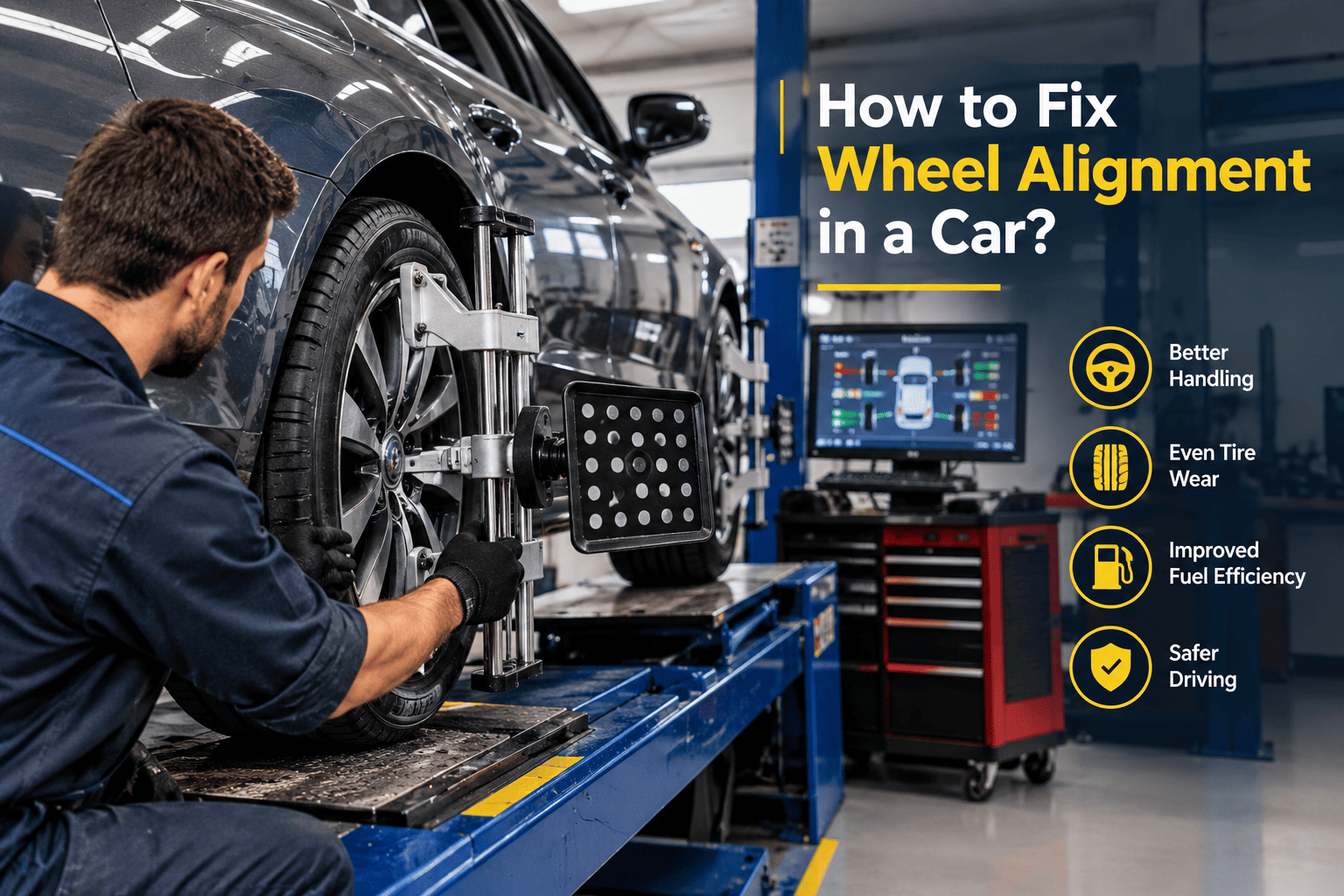
The current wheel geometry of the vehicle is measured by placing it on the alignment machine. The equipment determines the different measurements of the angles, including camber, toe, and caster, which helps in knowing the problems in the alignment and the solution of how to align car wheels.
| Measurement | What It Determines |
| Camber | Wheel tilt |
| Toe | Wheel direction |
| Caster | Steering axis angle |
| Thrust angle | Rear-wheel tracking direction |
Adjust the alignment settings
After obtaining the measurements, it becomes convenient for technicians to perform wheel alignment adjustments using the available vehicle wheel adjustment points.
Depending on the vehicle type, the adjustments may involve the tie rod adjustment, eccentric bolt and shims, etc. Different types of vehicles require different types of adjustments for the same alignment angles.
| Adjustment | Purpose |
| Tie-rod adjustment | Corrects toe angle |
| Camber adjustment | Corrects wheel tilt |
| Caster adjustment | Corrects steering axis angle |
| Rear toe adjustment | Corrects rear-wheel tracking |
| Steering wheel adjustment | Centers the steering wheel |
Verify the alignment
After finalizing the adjustment, technicians generally recheck the measurement angle to verify if the alignment is within the desired manufacturer’s range. They also check the steering wheel for its performance.
| Final Check | Desired Result |
| Alignment readings | Within vehicle specifications |
| Steering wheel | Centered |
| Tire tracking | Straight |
| Steering response | Stable and predictable |
| Road test | No abnormal pulling or wandering |
Final Thoughts
Looking for professional wheel alignment repair? Sawmill Auto Alignment is here to make your driving feel safe. Contact us at (914) 327-4777 for more information and to get your appointment booked. We make sure that your wheels are parallel to each other and are perfectly aligned to make your driving feel smooth and safe.
FAQs
What does wheel alignment do?
Wheel alignment adjusts the steering wheel and suspension components to make sure that the vehicle makes perfect contact with the road at an accurate angle.
How would I know if my vehicle needs wheel alignment?
Your vehicle needs wheel alignment when you notice that the tires are moving in a random direction while you are driving straight on a straight road.
Squealing sounds from the tires and noticing wear and tear on the tires require wheel alignment.
An off-centre steering wheel also indicates the need for wheel alignment.
How much does wheel alignment cost in Yonkers, NY?
The wheel alignment can cost $50 to $200 in Yonkers, NY, depending on the number of tires.
How long does it take in wheel alignment take?
The wheel alignment can be done within 40 to 90 minutes, depending on different circumstances.
How often do I need a wheel alignment adjustment?
Wheel alignment is required every 12000 to 15000 miles of travel, once a year or whenever you notice the signs of poor wheel alignment.